Goal, Project, or Habit: How to Pick the Right Format
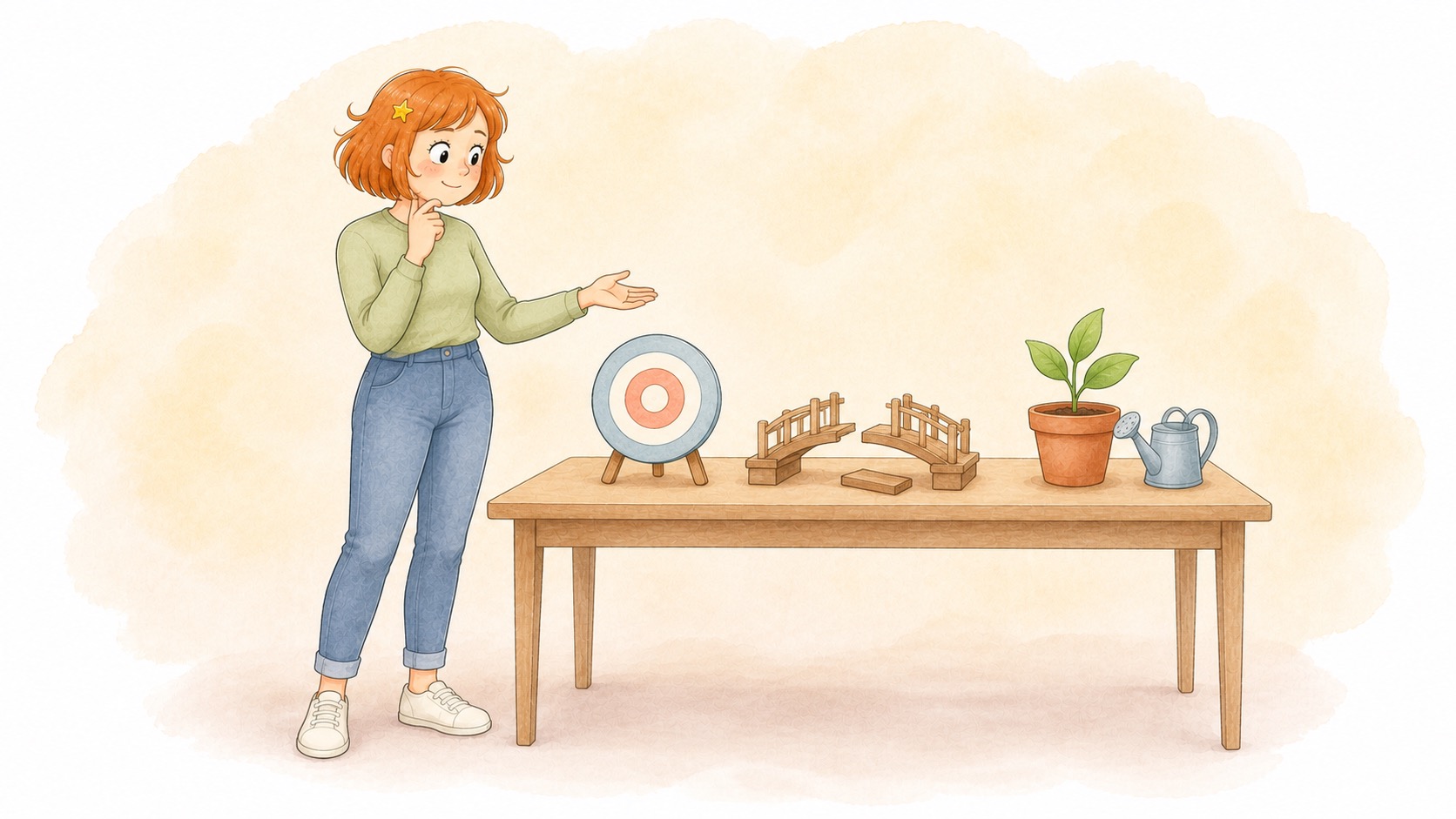
For three weeks I kept a list of goals. I tried to be honest about it: twenty-two goals, laid out by quarter, with deadlines and criteria. A month later two items were left, and I hadn't done either of them.
There was no laziness in it. I was holding different things in my head as if they were the same thing, and they need to be managed differently.
1. One Wish, Three Ways to Live With It
Take the classic: "I want to speak English fluently." One sentence glues together three different objects.
A goal is a result without a boundary. "Speak English fluently" can't be started and can't be finished. It can run ten years, and that's normal. You move toward a goal, you don't run it.
A project is a result with a boundary. "Do 12 conversation sessions by December 15" is already a project. It has a start, an end, and points in between where you can see you're moving.
A habit is a repeated action. "Read 20 minutes every evening" promises nothing. The result might never appear. But you always know whether you did it today or not.
The trouble starts when one person uses all three words for a single item. I've seen it many times: "my project, lose 10 kilos," "my habit, run in the morning," "my goal, learn Python." Most of the time it's one intention, renamed three times in six months.
2. Why the Confusion Eats Effort
Take "my project, lose 10 kilos." That project has no boundary, no daily action, no feedback. You don't know what exactly you're doing today, and you don't know when the project is closed. A month passes, you went to the gym five times, then stopped, because there was no way to tell "moving" from "not moving." Then you say you have a discipline problem. You have a format problem.
The reverse case: "my project, meditate every day." That's a habit named a project. And it backfires: you missed Tuesday, you slipped, ten days of practice reset in your head as a failed project. Nobody does it that way. A habit accumulates, and a miss stays a miss, it doesn't count as failure.
I did this myself with running. Two months of "the run-in-the-morning project," then a week off, and the whole thing was declared a failure. Even though I ran more in those two months than in the previous six.
3. Two Questions That Settle Everything
First: does this have an end?
A landing page is either ready or not. A course is either finished or not. But "fluent English" has no end, you can study it into old age. If there's no end, you've got a goal or a habit, not a project. A project needs a date, otherwise it's a wish with a signature.
Second: what do you control right now, the action or the result?
A habit is what you do. "Meditated 10 minutes," "read 20 pages," "went to the gym." The result doesn't depend directly on you: "became calmer," "learned the language," "lost 10 kilos." If your success criterion lives in someone else's zone, you'll be the one grading it, and you won't be able to do it. That's an expensive way to get disappointed on schedule.
What if the answers don't line up? Ask yourself: what do I do in this thing, and when do I finish? A goal that has a concrete action and a concrete date automatically becomes a project. A goal without a date and without a repeating action stays a dream until one of the two appears.
4. What the Research Says
Locke and Latham (2002) reviewed 35 years of goal-setting research. Short version: a concrete goal with a measurable criterion beats a vague one. "Run 10 km" and "run three times a week" produce different results, and it's not about difficulty: you can tell from them whether you're advancing or not. The paradox of a goal is that "learn English" can be neither completed nor failed, so it can't be checked off.
Further in, it gets more interesting. Vella and colleagues (2020) compared four goal-setting modes in a walking study: open ("see how far you can go"), SMART, "do your best," and a no-goal control. The open and SMART goals produced more distance than the control. But SMART produced noticeably more pressure and tension, while the open goal produced more interest in repeating. So specificity helps, but if you remove its upper bound, you get the same result without the feeling of being chased.
On habits, the numbers are these. Lally, van Jaarsveld, Potts, and Wardle (2010) tracked 96 people for 12 weeks: each picked one repeated action tied to a daily cue, like "after breakfast" or before dinner. The time for automaticity to reach 95% of its ceiling ranged from 18 to 254 days, median 66. They also checked misses: one missed opportunity lowered the automaticity score by less than half a point and didn't break the process. The planning takeaway is simple: budget two or three months for automaticity, not two weeks, and don't throw out a habit over one Tuesday.
Brandstätter and Bernecker (2022) collected the mechanisms of holding onto and letting go of goals in a review. It shows clearly that continuing to beat against an unreachable goal is costly: holding on produces a feeling of incompleteness that pulls on resources. Meanwhile, giving up a goal isn't failure, it's an independent regulatory move, described in the review as quite adaptive.
And Gollwitzer (1999) with his "if-then" plans. The phrasing "if I open my email, then I'll write three draft replies" works better than "I'll reply faster." A concrete condition ties the action to the moment when it usually happens.
5. What to Do
Take one thing that's currently hard for you. Not the most important, the one where you genuinely don't understand why it isn't working.
Name it in one sentence. "I want to learn English" isn't a formulation yet, it's a topic. Then the two questions we've covered: does it have an end? What do I control?
If there's no end and you control only the action, it's a habit. Make it daily and place it next to what's already happening in your day, not instead of it. A habit lives in the schedule, not in the wish list.
If there's an end, it's a project. Break it into parts, each part with its own chunk of work and its own check. A project without stages turns into a blank spot, and the brain walks around it because it's not clear which side to approach from.
If it's a goal, invent a project for it. The project is there so there's something to check off. "Fluent English" becomes "12 conversation sessions by March," and that can go on a calendar and show a result on Monday.
And test the formulation: in a week you should be able to say what exactly you did on Monday. If the phrasing can't survive that question, it's not ready yet.
ForgeSelf keeps goals, projects, and habits separate, because planning them in one list is pointless.
Sources: Locke E. A., Latham G. P., "Building a practically useful theory of goal setting and task motivation: A 35-year odyssey," American Psychologist, 2002. Vella A., Allen M., Hutto M., Mulla M., Peoples H., Schweickle M., Hooper A., Swann C., "Comparing the effects of goal types in a walking session with healthy adults," Psychology of Sport & Exercise, 2020. Lally P., van Jaarsveld C. H. M., Potts H. W. W., Wardle J., "How are habits formed: Modelling habit formation in the real world," European Journal of Social Psychology, 2010. Brandstätter V., Bernecker K., "Persistence and Disengagement in Personal Goal Pursuit," Annual Review of Psychology, 2022. Gollwitzer P. M., "Implementation intentions: Strong effects of simple plans," American Psychologist, 1999.
Content is created with AI based on scientific papers on hand-picked topics. I would be glad to get help from a human editor — send your CV to support@forgeself.com