What to Do When Starting a Big Project Scares You
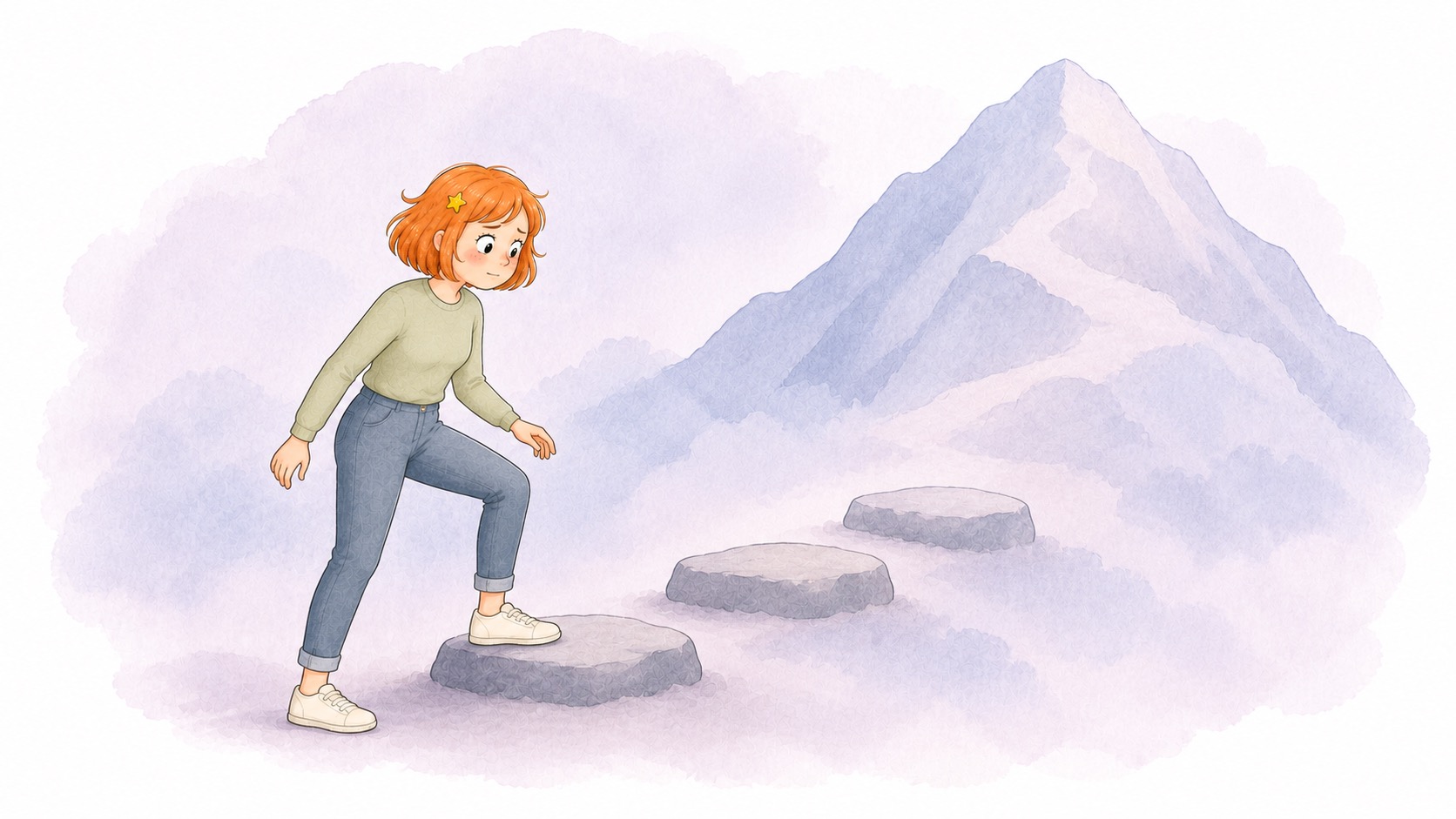
A friend of mine spent a year and a half getting ready to record a podcast. Didn't brainstorm topics, didn't look for guests, just didn't start. I ask why. He says: "I'm afraid no one will listen." So he's afraid of a result that doesn't exist yet. And that fear has paralyzed him for eighteen months. Familiar?
Fear of an important thing isn't rare and isn't pathological. It's a normal reaction to uncertainty. The question is what to do with it.
Why Fear Shows Up Now
Fear of starting isn't laziness. It's because the project matters to you. If you'd invested nothing in it, there'd be no fear.
Usually one of three things hides behind it.
First, fear of not being who you thought you were. For months you've thought of yourself as someone capable of running their own project. The first week of work can shatter that image. That's unpleasant, so the brain tries to postpone it.
Second, fear of wasting time. Especially if there were earlier attempts that didn't take off. Each new run is hope, but also the risk of a new disappointment.
Third, fear of the unknown. A project that doesn't exist yet can be anything. Perfect. The moment you start, it becomes real, with all its flaws. That transition is scary.
None of these makes you weak or unready. It's just the nervous system doing its job.
What Fear Does to Decisions
Fear rarely comes in pure form. It hides.
Sometimes it disguises itself as perfectionism. "I'll start when the preparation is perfect." Formally you're preparing. Actually you're not starting.
Sometimes fear hides in analysis. "I need to think a bit more." You browse articles, listen to podcasts, study other people's experience. It can look like productivity. But if it goes on longer than three weeks without a single real step, it's avoidance.
Sometimes fear shows up as hyperactivity elsewhere. You're not lazy, you're working. Just on things that aren't scary. Check your to-do list. How much of it moves the main project forward?
Three Approaches That Don't Work
First: "Just do it." It sounds like advice, which is exactly why it doesn't work. The brain doesn't respond to slogans. It needs specifics, not a motivational phrase.
Second: wait for the fear to pass on its own. It won't. It might get quieter, but it doesn't go away. Waiting for the perfect moment is the avoidance itself.
Third: convince yourself the fear is wrong. "What am I afraid of, it's just a podcast." Devaluing doesn't work. If the project matters, it will be scary. That's not a bug, that's a feature.
What Works: Three Methods
First: name the fear out loud. Not "I'm scared," but specifically: "I'm afraid no one will come," "I'm afraid I'm not who I thought," "I'm afraid of another failed run." Once named, the fear takes up less space. It stops being foggy anxiety and becomes a concrete obstacle. And you can work with a concrete obstacle.
Second: split the project into two parts. What you can do without evaluation, and what requires outside reaction. Writing a book: the writing is the first, reader reaction is the second. Do the first without waiting for the second. Publishing, sales, reviews, all of that happens after, not before. Fear of readers isn't what stops your work on the text.
Third: set a concrete time when the project will be "good enough." Not "good," not "right." Good enough. Ashley Goodman, who studied perfectionism, recommends defining the readiness criterion in advance and not moving it later. It's hard. But it's the only way to stop improving details forever.
What If the Fear Doesn't Go Away
Sometimes you try and the fear stays. That's normal. It's not required to leave. It just must not decide for you.
Robert Nideffer, who studied anxiety in athletes, found something interesting: the best results came from people who acknowledged the fear but acted anyway. Not from people who had no fear. From people who had it, and it didn't stop them.
Reading won't replace action. But if you feel stuck, it can help to read how others worked with fear. Not to make the fear disappear, but to see that having it isn't a sentence.
What to Do
Figure out which specific fear sits behind your "I'm not starting." Write it on paper. Concretely, in one sentence. Not "I'm afraid of failure," but "I'm afraid I'll spend six months and discover no one needs it."
Separate what you can do without evaluation from what needs feedback. Do the first now. The second when you get there.
Set a time when the project will be "good enough." Write it down. If you want to keep going after that, improve. But the cutoff has to be set in advance.
And one more thing. Fear doesn't mean you're not ready. Sometimes it means you are. The project is just serious, and there's something to lose. It's an unpleasant but accurate feeling.
ForgeSelf tracks not just tasks, but time spent thinking. If you want to see how many weeks went into "preparation," you can. It's not judgment, just information.
Sources: Ashley Goodman, Randy Paterson, "When Perfect Isn't Good Enough," 2009. Robert Nideffer, "Athlete's Guide to Winning," 1992. Julian Z., decision timing under uncertainty.
Content is created with AI based on scientific papers on hand-picked topics. I would be glad to get help from a human editor — send your CV to support@forgeself.com