Why Discipline Isn't About Willpower
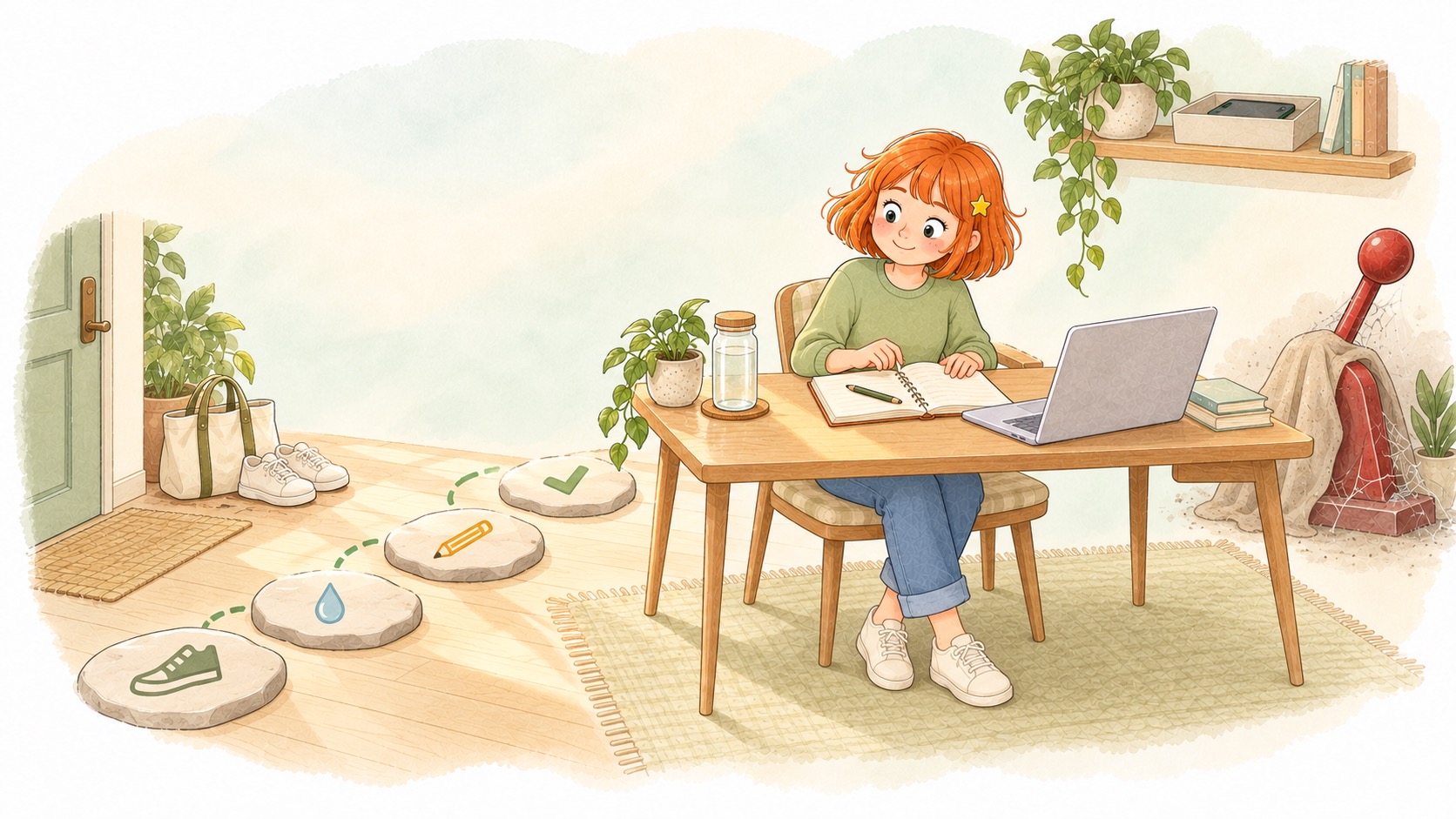
You're on the couch. You need to get up and do the thing. It feels impossible. You decide you lack motivation. You try visualization, affirmations, another cup of coffee.
Nothing helps.
The problem isn't you. It's that your nervous system is already running at its limit, from chaos, uncertainty, and a million small decisions you make every day.
1. The Mind Isn't a Muscle
Discipline is usually framed as "willpower you need to train." That metaphor is harmful.
Willpower is a finite resource. Roy Baumeister's research showed self-control gets spent. Every decision, every act of suppressing a desire, drains the account.
Here's the key part: deciding "what to eat for breakfast" and deciding "stay calm in a hard meeting" draw on the same resource. Ego gets depleted by everything. Not just work.
So "just force yourself" doesn't work. The resource is limited and runs out fast.
2. Chaos Is the Main Energy Drain
Your nervous system doesn't know what's coming in two hours. The next task? Unpredictable. How much today? Fuzzy. When's lunch? Whenever.
Unpredictability is a threat signal. Even when there's no threat. The brain still keeps you on alert, just in case.
Hence: morning fatigue without any physical effort. Procrastination. The feeling you're "doing nothing" while working eight hours.
You're not lazy. You're exhausted by uncertainty.
3. Structure Takes the Load Off
When you have a morning routine, you don't spend energy on "what should I do now." The routine already decided. Get dressed, wash up, breakfast. Done.
When you have a clear plan for the day, you don't hold "don't forget to do X" in your head. The list is external memory. The mind hands that job to the paper and exhales.
This isn't perfectionism. It's mechanics: every unsolved task in your head is a little background process. A list of 15 things is 15 micro-processes spinning. They don't rest. You can hand them to a system.
4. Predictability Neutralizes Anxiety
When you know tomorrow is Monday, work runs 10 to 7, workouts are Wednesday and Friday, the brain can relax. Not right now, but overall.
Anxiety usually grows from uncertainty about the future, not from bad events. "I don't know what'll happen" is scarier than "it'll be bad, but clear."
A stable life isn't boring. It's a reduction in background tension. The brain stops keeping you in "what if" mode.
5. What to Do
Don't try to train willpower. You can't train it. You can change the system.
Morning routine: three or four actions that are always the same. Clothes, breakfast, twenty minutes of prep. No choice.
Evening planning: five minutes, write down three things for tomorrow. Not a full day list, priorities. The small stuff goes in the system.
A structured week: a sense of what happens Monday, Tuesday, Wednesday. Not a rigid schedule, but roughly which day does what.
ForgeSelf shows the structure of your day and week. Habits with a tracker aren't about self-control. They're an external system that takes the load off the nervous system.
Sources: Roy Baumeister, "Willpower," 2011. Gloria Mark, "The Effects of Interruptions on Electronic Work," 2004. Robert Sapolsky, "Why Zebras Don't Get Ulcers."
Content is created with AI based on scientific papers on hand-picked topics. I would be glad to get help from a human editor — send your CV to support@forgeself.com